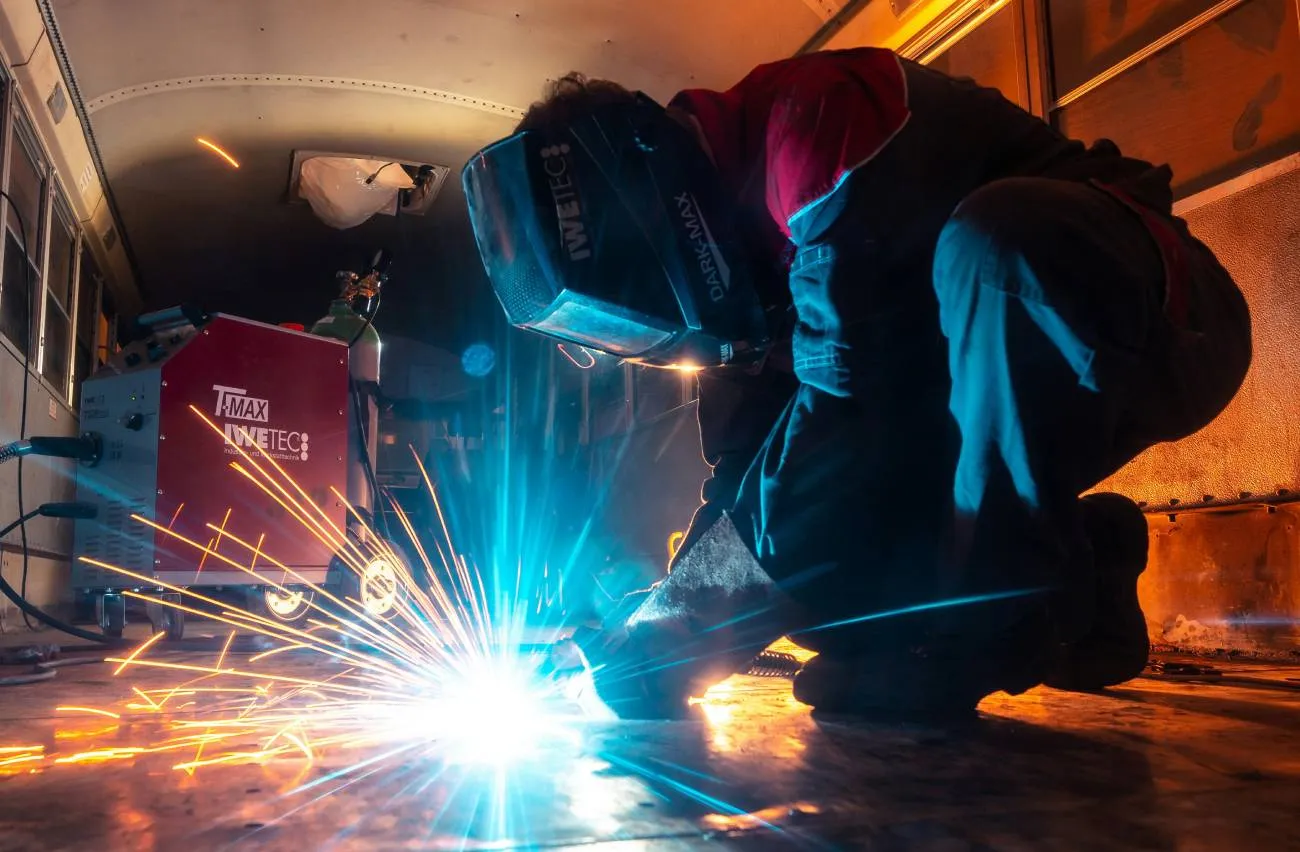
Welders are exposed to numerous risks — burns, radiation, toxic fumes, noise — which necessitate the implementation of Collective Protective Equipment (CPE) and Personal Protective Equipment (PPE). They are required to wear appropriate welding helmets, safety glasses, clothing, gloves, and footwear, as well as hearing protection.
However, your risk assessment will determine the additional protections needed based on your environment and processes. In this comprehensive guide, we detail all the equipment required to work safely.
What Collective Protective Equipment (CPE) for Welding?
CPEs are prioritized in the hierarchy of prevention measures (before PPE, as they protect everyone and do not depend on individual behavior).
Here are the main CPEs to consider for a welding workshop or site:
Ventilation and Fume Extraction
- Local exhaust ventilation (LEV) systems (articulated arms, nozzles) to prevent the inhalation of gases and metallic dusts (manganese, lead, ozone, etc.).
- General ventilation to renew the air and prevent the concentration of flammable or toxic gases.
Fire Protection
- Fire-resistant barriers and welding screens or curtains (made of flame-retardant fabric or opaque panels) to protect other workers from sparks and radiation.
- Appropriate fire extinguishers (CO₂, ABC powder) and water points nearby.
- Clear and non-flammable floors (avoid wood, paper, solvents, etc.).
Signage and Demarcation
- Welding area delimited and clearly marked with warning signs (radiation, fire risk).
- Visual screens to protect others from glare.
Noise Reduction
- Sound-absorbing materials on walls/ceilings or soundproofed cabins for particularly noisy welding operations (plasma cutting, etc.).
Organization and Storage
- Stable workbenches, supports for gas cylinders with chains.
- Cables, torches, and cylinders stored properly to prevent falls or impacts.
What Personal Protective Equipment (PPE) for Welders?
PPE protects the welder themselves and is mandatory when CPE alone is insufficient to eliminate risks.
Here are the main PPE items for a welder, categorized by body part:
👀 Eye and Face Protection
- Welding helmet or hood with a specific filter (DIN 9 to 14 depending on the process and intensity), protecting against UV, IR, and intense light.
- Clear visor or face shield for grinding or descaling.
- Safety glasses (even under the helmet) to prevent projections during preparation or finishing.
👂 Hearing Protection
- Earplugs or earmuffs, especially in workshops with grinding, cutting, or noisy welding.
👃 Respiratory Protection
- Respiratory mask with filter cartridges (P3 + A1 type) against metallic dusts and fumes.
- Or supplied-air system or powered air-purifying respirator (PAPR) for prolonged work or in confined atmospheres.
🧤 Hand Protection
- Leather welding gloves, insulating, resistant to heat, sparks, and cuts.
- Long fingers and gauntlets to also protect the wrists.
👕 Body Protection
- Flame-retardant clothing or treated cotton (EN ISO 11611 standard).
- Leather or flame-retardant fabric apron to protect the torso.
- Sleeves or closed jackets to prevent sparks from entering.
- Flame-retardant trousers covering the ankle well (without cuffs to avoid collecting sparks).
- Leather spats for work in a kneeling position.
- Safety footwear (S3) made of leather, with toe caps, resistant to heat and punctures.
How to Choose Between Welder’s PPE or CPE?
Collective protection should always be prioritized over individual protection. Here is a table that inventories the most common protections:
| Part to Protect | CPE | PPE |
|---|
| Eyes & Face | Collective protective screens | Welding helmet, safety glasses |
| Respiration | Fume extraction, ventilation | Respiratory mask |
| Hearing | Soundproofed cabins | Earplugs or earmuffs |
| Body & Hands | Fire-resistant barriers, curtains | Flame-retardant clothing, gloves, apron |
| Feet & Legs | Clear floor, non-flammable floor | S3 safety footwear, spats |
| Environment | Signage, fire extinguishers | Training and vigilance |
How to Protect the Welder in Special Situations?
Your risk assessment will answer this question, but here are the most common specific welding scenarios:
| 🪜 Situation | ⚠️ Risks | 🛡️ Main Solutions | 📌 Concrete Examples |
|---|
| At height | Falls | Guardrails, harnesses, nets, demarcation | Work on roofs, scaffolding, aerial work platforms, ladders |
| Kneeling | Musculoskeletal disorders (MSDs), joint pain | Kneepads, cushions, regular breaks, task rotation | Tiling, floor welding, machine maintenance |
| In confined spaces | Asphyxiation, toxic or explosive atmosphere, difficulty of evacuation | Ventilation, gas detectors, harnesses, external monitoring | Tanks, ship holds, silos, sewers |
| In slippery environments | Falls, electrocution | Anti-slip floors, SRC footwear, demarcation, drainage | Pontoons, docks, construction sites in the rain, wet areas |
| In hot/cold environments | Heatstroke, dehydration, hypothermia, frostbite | Appropriate clothing, breaks, shelters, water available | Construction sites in direct sunlight in summer, in cold rooms, outdoors in winter |
| In noisy environments | Hearing loss, secondary accidents related to poor communication | Source reduction, earplugs, earmuffs | Demolition, grinding, cutting, shipyard |
The type of welding influences the arc’s brightness, the frequency of sparks, the light stability, and the sensor sensitivity.
The helmet is mainly adapted using these criteria:
- Shade level (DIN protection level)
- Cell reaction time (or darkening delay)
- Sensor sensitivity
- Light-to-dark delay (clear > dark > clear)
- Comfort and mechanical protection
Here is a table covering the main cases:
| Characteristic / Process | Shielded Metal Arc Welding (SMAW) | MIG/MAG Steel | MIG/MAG Aluminum | TIG |
|---|
| Typical Current Range | 40–300 A | 50–500 A | 50–350 A | 5–300 A |
| Recommended Shade (DIN) | 10–13 depending on intensity | 11–13 | 11–13 | 9–13 |
| Sensor Sensitivity | Medium (arc very visible) | Medium | Medium | High (low amperage arc) |
| Reaction Time (darkening) | $\le$ 0.1 ms | $\le$ 0.1 ms | $\le$ 0.1 ms | $\le$ 0.1 ms |
| Light-to-Clear Delay (adjustable) | ~0.1–1 s depending on comfort | ~0.1–1 s | ~0.1–1 s | ~0.1–1 s |
| Resistance to Projections | Very important | Very important | Very important | Important (fewer projections) |
| Field of View | Standard | Wide recommended | Wide recommended | Standard, but good clarity |
| Weight / Comfort | High priority (often prolonged) | High | High | Very high (often uncomfortable positions) |
| Grind Mode (useful?) | Yes (frequent changes) | Yes | Yes | Yes |
| Natural Light Option (clarity) | Useful but secondary | Useful | Useful | Very useful (for precision at low current) |
| Number of Sensors | 2–3 sufficient | 3–4 recommended | 3–4 recommended | 4 recommended (for reliable detection even at low current) |
For greater rigor, follow the standards you deem applicable according to your region and choices:
| Standard | Region | Title / Subject | What it Defines |
|---|
| EN 166 | Europe | Personal eye protection | General requirements for all eye protectors: mechanical, optical, chemical resistance, etc. |
| ANSI Z87.1 | USA | Occupational and Educational Personal Eye and Face Protection Devices | General requirements for eye and face protection: impact, splash, heat, chemical resistance, visibility. |
| CSA Z94.3 | Canada | Eye and Face Protectors | Similar requirements to ANSI, adapted to Canadian conditions. |
| EN 169 | Europe | Filters for welding | Fixed shade scale (DIN), light transmission, optical quality for non-automatic filters. |
| ANSI Z87.1 (fixed filters) | USA | Welding Filter Lenses | Equivalent to DIN filters: recommended shades, light transmission, optical safety. |
| EN 379 | Europe | Automatic welding filters (ADF) | Criteria for electronic filters: variable shade, reaction time, optical uniformity, low-intensity arc detection. |
| ANSI Z87.1 (ADF) | USA | Auto-Darkening Filters (ADF) | Criteria for ADFs: reaction time, permanent UV/IR protection, sensitivity, optical performance. |
| EN 175 | Europe | Equipment for eye and face protection during welding and allied processes | Requirements for mechanical design of shells/helmets: resistance to impact, projections, heat. |
| ANSI Z87.1 (Helmet/Shell) | USA | Faceshields & Welding Helmets | Mechanical and thermal resistance of helmets/shells for welding and grinding. |
| EN 166/EN 167/EN 168 | Europe | Test methods | How to test resistance, clarity, robustness, etc. |
| EN 379 Annex B | Europe | Optical classes for ADF | Optical classification (1/1/1/1 = maximum) on: optical clarity, diffusion, homogeneity, angular dependence. |
| ANSI Z87.1 (ADF classes) | USA | Optical Quality and Performance | Evaluates ADFs on similar criteria, but without the “1/1/1/1” rating. |
| EN ISO 16321-1/-2 | Europe/ISO | Eye and face protection for welding and allied processes (replaces EN 175) | Harmonizes global requirements (Europe, ISO, sometimes ANSI/CSA). Gradually replacing EN 175. |
| EN 12477 | Europe | Protective gloves for welders | Specific criteria for gloves (mechanical, thermal resistance, projections). |
| ANSI/ISEA 105 | USA | Hand Protection | Evaluates gloves in terms of mechanical, thermal, and chemical resistance for welders. |
Practical Tips:
- Choose a helmet with a variable shade range if you practice multiple processes.
- For low-intensity TIG (<20A), ensure the helmet is certified for low intensity (some detect down to 2A).
- If you often switch from welding to grinding, opt for a helmet with a dedicated grind mode.
- In very bright environments, increase sensitivity to prevent the helmet from accidentally triggering.
- In dark environments, decrease sensitivity to prevent ambient light from interfering with triggering.
What Respiratory Protective Equipment to Choose?
Before choosing RPE, you need to know what you are protecting against, as not all devices protect against everything.
Possible Risk Types:
🛑 Dusts, metallic fumes, fine particles
🛑 Irritant or asphyxiating gases (CO, ozone, NOₓ, solvents, etc.)
🛑 Oxygen-deficient atmosphere (<19.5%)
🛑 Potentially explosive atmosphere
Filtering Devices
They filter ambient air, but do not create clean air and do not protect in case of oxygen deficiency or high gas concentration.
Suitable if:
- ✅ there is sufficient oxygen (>19.5%)
- ✅ the concentration of contaminants remains below the usage limits of the chosen RPE
Types of Filtering Devices:
| Type | Protection Against | Examples |
|---|
| FFP1 / FFP2 / FFP3 Masks | Dusts, fumes, particles | FFP2 or FFP3 for welding |
| Cartridge Masks (half-mask or full-face) | Particles + certain gases/vapors (depending on cartridge) | P3 for metallic particles + A1 for solvents |
| Powered Air-Purifying Respirators (PAPR) | Particles + gases (depending on filters) with improved comfort | Helmet with integrated ventilation for long durations |
Insulating Devices
They provide air independent of the ambient air, essential:
- in oxygen-deficient atmospheres
- in highly contaminated atmospheres (non-filterable)
- in confined spaces (non-ventilated)
Types of Insulating Devices:
| Type | Operation | Example |
|---|
| Supplied-Air Respirator | Air supplied by hose from outside | Prolonged work in confined spaces |
| Self-Contained Breathing Apparatus (SCBA) | Air cylinder carried by the user | Short interventions, rescue |
Consider Duration, Effort, and Comfort
- For short tasks with low concentration → filtering masks (FFP2/FFP3 or cartridges).
- For long or strenuous tasks → powered air-purifying respirators (PAPR) to reduce fatigue and breathing resistance.
- For unknown or dangerous atmospheres → insulating device.
Good Practices:
✅ Verify airtightness (fit test) and compatibility with other PPE (helmet, glasses).
✅ Change filters or cartridges as soon as they are saturated or at the end of their service life.
✅ Train users on wearing, maintaining, and the limits of their RPE.
✅ Never use a filtering device in an oxygen-deficient atmosphere.
Good Practices for Organizing Welding Activity
To guarantee the safety of operators and avoid any legal risk, it is not enough to choose appropriate protective equipment. It is equally essential to rigorously organize welding activity: anticipate risks, train and supervise personnel, maintain equipment in good condition, and ensure that the work environment remains safe and compliant with regulatory requirements. The good practices below illustrate this comprehensive approach to prevention.
- Always conduct a prior risk assessment to identify specific hazards.
- Train personnel on how to properly use and maintain their PPE.
-
Regularly check the condition of PPE and CPE.
- Replace worn or damaged equipment.
- Never wear synthetics (they melt and burn the skin) or oil/solvent-stained clothing.
- Keep exits clear and emergency equipment accessible.