FREE
To get started, and for small teams that need nothing more.
€0
Forever. No credit card.
- Up to 100 items
- Up to 10 tracked people
- Unlimited users
The complete guide to tracking, inspecting and managing your personal protective equipment
Centralize your PPE inventory, automate periodic inspections, and stay compliant with OSHA 29 CFR 1910 Subpart I—without spreadsheets or paperwork.
A PPE management software (Personal Protective Equipment) is an application that centralizes all your safety equipment, their lifecycle, their periodic inspections, and their assignment to employees. It replaces scattered Excel files and paper binders with a single database, updated in real time, accessible from any computer or smartphone.
In concrete terms, a PPE software like GearTracker lets you maintain a digital PPE inventory aligned with OSHA 29 CFR 1910 Subpart I, schedule automatic alerts before every inspection due date, scan equipment in the field via QR code or NFC, and generate in a few seconds the reports your internal auditors, insurance carriers, or OSHA inspectors will ask for.
GearTracker does not stop at PPE: it also tracks the compliance of the teams who wear it (training, certifications and authorizations, medical checks, documents with read acknowledgement) and incident reporting (hazardous situations, near misses, corrective actions). One person, two registers: their equipment, and everything that concerns them.
It is today’s go-to tool for EHS managers, safety coordinators and PPE program administrators in industrial settings, used to manage their PPE program without spending several hours a week on paperwork.
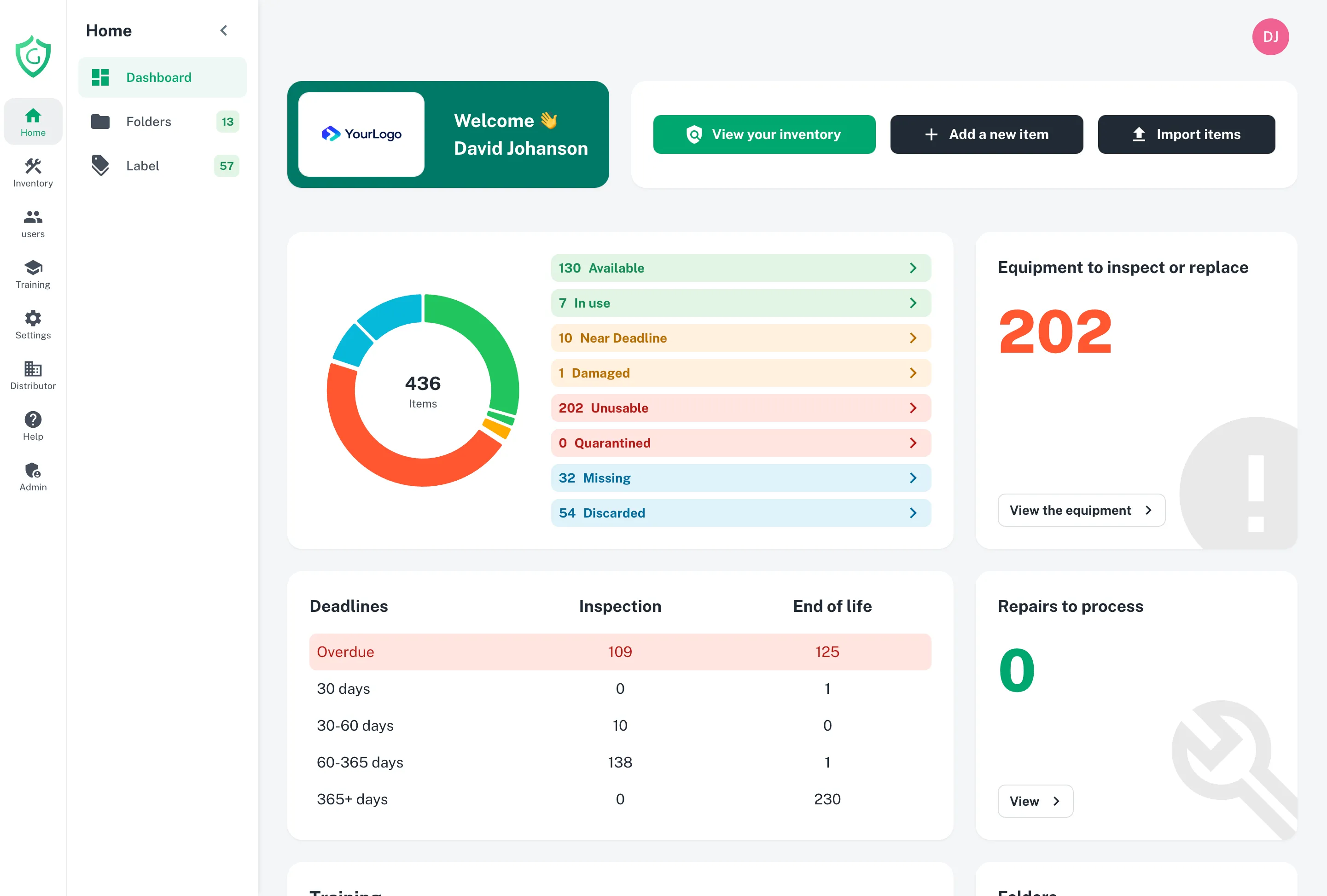
GearTracker dashboard: a single view of your PPE compliance, inspection deadlines, training status, users and folders.
Unlike the European classification system (categories I, II, III under EU regulation 2016/425), the United States regulates PPE by type. The framework is set by OSHA for general industry (29 CFR 1910 Subpart I) and construction (29 CFR 1926 Subpart E), with the performance levels of each item defined by ANSI/ISEA, ASTM and NIOSH standards.
| PPE type | OSHA standard | Performance standard | Typical tracking focus |
|---|---|---|---|
| Eye and face protection | 1910.133 | ANSI Z87.1 | Visual check before each use, fit |
| Head protection | 1910.135 | ANSI Z89.1 (Type I/II, Class E/G/C) | Replacement per manufacturer, impact damage |
| Foot protection | 1910.136 | ASTM F2413 | Wear, sole integrity |
| Hand protection | 1910.138 | ANSI/ISEA 105, ANSI/ISEA 138 | Cut/impact level vs. task, condition |
| Hearing protection | 1910.95 | ANSI S3.19 / S12.6 (NRR) | Fit, audiometric testing |
| Respiratory protection | 1910.134 | NIOSH approval (N95, P100, SCBA…) | Written program, fit-test, cartridge change-out |
| Personal fall protection | 1910.140 / 1926.502 | ANSI Z359 series | Inspection before each work shift, immediate removal after impact load |
| Electrical protective equipment | 1910.137 | ASTM D120, D178, F496 | Periodic dielectric testing |
The two categories that demand the most rigorous tracking are respiratory protection (which requires a written program under 1910.134(c)) and personal fall protection (which requires inspection before each work shift and post-impact removal per 1910.140). These are also the items where a software like GearTracker delivers the most value, since a missed inspection can lead to a fatal incident and trigger the General Duty Clause Section 5(a)(1).
Without a dedicated solution, PPE management often relies on Excel files or handwritten notes. That works as long as the inventory is small and one person handles it. As soon as the company grows, the limits show up fast: lost information, missed inspections, version conflicts between teammates, no mobility in the field, and non-compliance findings at audit time.
A software like GearTracker lets you:
Where Excel demands constant human discipline (and always fails on audit day), software enforces the rigor by design: you cannot miss an inspection, you cannot lose the history, and you cannot end up with two divergent versions of the same file.
OSHA does not call it a “PPE register,” but the agency requires you to maintain several written records that, together, form the PPE recordkeeping backbone you must be able to produce on demand.
The two written certifications required by 29 CFR 1910.132
The additional records OSHA expects to see
Why these records are often neglected. Three reasons come up in the organizations we work with: management thinks that buying compliant PPE is enough, the paper-based recordkeeping is too tedious to keep current, and no one is formally designated as the PPE program administrator. A software like GearTracker removes all three: the records build themselves automatically as PPE is added, assigned, inspected and removed.
PPE management is regulated by a coherent stack of federal standards. Here is what you actually have to do.
The regulatory framework
The foundation is 29 CFR 1910 Subpart I — Personal Protective Equipment for general industry, and 29 CFR 1926 Subpart E for construction. The umbrella section is 29 CFR 1910.132 — General requirements, which covers hazard assessment, selection, training, payment and defective equipment. It is complemented by item-specific standards (1910.133 to 1910.140) and by ANSI/ISEA, ASTM and NIOSH performance standards referenced by OSHA.
The 9 core obligations of the employer
For temporary workers, both the staffing agency and the host employer share OSHA responsibilities — a written agreement should clarify who provides which PPE. For contractors and subcontractors on multi-employer worksites, OSHA’s multi-employer citation policy can hold the controlling employer responsible for hazards affecting other employers’ workers.
State plans
About half of US states (CA, MI, WA, OR, NC and others) run OSHA-approved State Plans that must be at least as effective as federal OSHA. Some go further (e.g., Cal/OSHA’s stricter heat illness and lead standards). Make sure to check your state-specific requirements alongside federal OSHA.
Industry frameworks and management standards
Link with your Job Hazard Analysis (JHA)
Your JHA identifies job-by-job hazards and the controls (engineering, administrative, PPE) that mitigate them. PPE is a control of last resort — but it must be tracked and proven. A PPE management software supplies the proof of execution for the PPE controls listed in your JHA, which is exactly what an OSHA inspector or an insurance auditor will ask for in the event of an incident.
Penalties for non-compliance
Failure to provide compliant PPE, perform the required certifications, or maintain inspection records can result in OSHA citations carrying civil penalties up to $16,550 per serious violation and up to $165,514 per willful or repeated violation (effective January 15, 2025, adjusted annually for inflation). The financial pain rarely stops there: increased workers’ compensation Experience Modification Rate (EMR), higher insurance premiums, loss of contractor qualification with major owners, and — in severe cases — referral for criminal prosecution under Section 17(e) of the OSH Act.
Before investing in a software, it is fair to ask whether the tools you already have are enough. Here is an unflinching comparison of the three approaches.
| Criteria | 📄 Paper | 📊 Excel | 💻 Dedicated software |
|---|---|---|---|
| Central inventory | ❌ Scattered binders | ⚠️ Multiple files | ✅ Single source of truth |
| Automated alerts | ❌ None | ❌ None | ✅ Email + push |
| Concurrent users | ❌ | ⚠️ Version conflicts | ✅ Real-time |
| Field access (mobile) | ❌ | ❌ | ✅ Mobile app + scan |
| Historical traceability | ⚠️ Fragile (loss, damage) | ⚠️ Fragile (overwrites) | ✅ Audit-proof |
| Audit-ready reporting | ❌ Hard to reconstruct | ⚠️ Manual reconstruction | ✅ One-click report |
| PDF report generation | ❌ Manual | ⚠️ Manual formatting | ✅ Automatic |
| Upfront cost | Low | Low | Moderate (subscription) |
| Hidden cost (time burn) | Very high | High | Low |
| Risk of data loss | Very high | High (crashes, viruses) | Low (cloud backups) |
| Scales with the company | ❌ Unmanageable past 50 items | ⚠️ Unmanageable past 200 items | ✅ No ceiling |
The verdict is unambiguous: paper works for a micro-business with fewer than 30 PPE items, Excel survives a few years in a low-risk SMB, and software becomes essential as soon as you cross 100 items or face audits (OSHA, ISO 45001, ISN, Avetta, major owners).
Not every PPE software delivers the same value. Here are the capabilities a serious tool must cover — and that you’ll find in GearTracker.
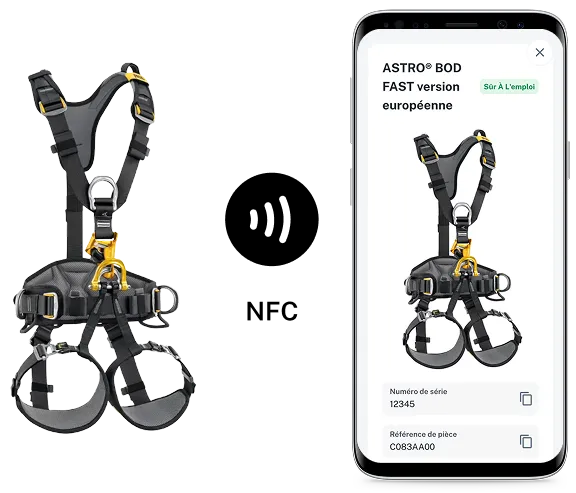
Field scan via NFC or QR code: the inspector pulls up the PPE record in a second — no manual data entry.
PPE management concerns every employer where a workplace hazard exists, but a few industries carry particularly critical stakes.
Oil & gas and petrochemical
Chemical-resistant suits, SCBAs, chemical gloves, face shields: these sectors concentrate the highest-stakes PPE under 1910.134 (respirators) and 1910.140 (fall protection). ISN/Avetta qualification is often a contractual must-have with majors (ExxonMobil, Chevron, Shell), and the PPE program is one of the first things their HSE auditors review.
Energy and utilities (including nuclear)
Site-specific qualifications, augmented traceability of wear time, pre-shift inspections before sensitive interventions: documentation rigor is non-negotiable. A software lets you align PPE management and qualification management in a single tool.
Manufacturing and metals
Hearing protection, welding shields, dust masks, cut-resistant gloves: high volumes, frequent turnover, multi-shift operations. NFC or QR code scanning transforms day-to-day management.
Construction (29 CFR 1926)
Hard hats, safety boots, gloves, eye protection, fall arrest: highly mobile crews, multiple project sites, subcontractors to track. A mobile-first software is indispensable, and your OSHA 300 log readiness depends on disciplined PPE tracking.
Working at heights and rope access (SPRAT / IRATA)
Harnesses, lanyards, lifelines, descenders: 100% require pre-shift inspection by a Competent Person (1910.140) plus periodic detailed inspection. This is the historical heartland of PPE management software.
PPE distributors and resellers
Beyond end-user companies, PPE distributors have a clear strategic interest in offering a management software to their customers: it is a high-value service that drives loyalty, justifies margin and differentiates from a transactional sale of gear. GearTracker is built for this with native sub-account management: from your distributor account you create and administer your customers’ accounts in a few clicks, monitor their activity, and bundle (or charge for) the tool as part of your service offer. It is also a powerful retention play: a customer that runs their PPE program inside your solution naturally renews with you.
Recreation and adventure professionals (sidebar) — Arborists (ISA-certified), zipline and adventure park operators, mountain guides (AMGA), professional ski patrol, swift-water rescue teams: same obligations as working at heights, with a strong seasonality that makes automated reminders indispensable.
Effective PPE management calls on several complementary roles. A software like GearTracker gives each one of them access tailored to their scope — without overloading anyone.
Many organizations underestimate the real cost of running PPE management by spreadsheet. Here are the line items to weigh before comparing the price of a software.
Direct visible costs
Hidden costs that hurt much more
Stacked together, these costs almost always exceed — by a wide margin — the investment in a software like GearTracker, which usually pays for itself within months on administrative time savings alone.
Not every PPE software is the same. Before signing, run through these 8 points with your prospective vendor.
Standing up a PPE management software shouldn’t be a multi-month project. With GearTracker, deployment usually takes less than a week. The reasons are simple:
In one to two weeks, your PPE inventory is digital, your inspections are scheduled and your field teams are up and running.
GearTracker was built around a simple principle: a PPE software should give your safety coordinator time back, not eat into it. That’s why we double down on:
🛡️ GearTracker streamlines your internal audits, locks in your compliance, and gives several hours a week back to your EHS team.
We’re convinced GearTracker is the solution you need. Get started for free: the tool is free up to 100 equipment items, with no time limit, no credit card and no commitment.
Set the two sliders to see the line-by-line breakdown and the total.
Free up to 100 on the FREE plan. On PRO you pay the tier you reach, the first one at least, and the price per item falls as you grow.
People with at least one medical check, certification or training course. Everyone else is left out of this count. Free up to 10. From 11, every one is billed: €1.10 per person per month (€1 on annual billing).
To get started, and for small teams that need nothing more.
When you go past 100 items or 10 tracked people. Same features, you only pay for what you track.
Payment: credit card or SEPA Direct Debit, your choice when you subscribe.
Start for freeFor very large fleets, or when your purchasing goes through a contract.
Also: dedicated onboarding and follow-up, priority phone support, SSO, payment by bank transfer or purchase order and tailored contract terms.
Try before you sign: 30 days free, started from the app, no credit card. Up to 500 items and 50 tracked people; when it ends, your data stays.
No feature is kept for paid plans. From one plan to the next, only the volumes change: equipment, tracked people and the AI assistant's monthly quota.


HSE Manager at Capgemini
This tool is a real performance driver for our business. The platform is intuitive, seamless, and particularly easy to use. Quick access to information and the automation of many tasks enable us to save significant time every day while improving the efficiency of our processes.
Thanks to this solution, our teams can focus on higher-value tasks, which directly helps improve our productivity. Reliable, high-performing, and perfectly suited to our needs, this tool brings real added value to any organization looking to optimize its operations and become more efficient. I highly recommend it.


Warehouse Manager at Bonduelle
Since we started using GearTracker last year, our experience has been extremely positive.
The platform has significantly simplified the management of our personal protective equipment (PPE) and other regulated equipment. Features such as deadline alerts, incident tracking, and repair monitoring have allowed us to save valuable time and ensure the safety of our teams.
What truly sets GearTracker apart is the quality of relationships with the founders. Their responsiveness is exemplary. Their personalized support has made all the difference, making the integration of the solution smooth and efficient. We highly recommend GearTracker to any organization looking to optimize their equipment management.
CAF Annecy
At CAF Annecy, we were looking for a simple and effective solution to manage our PPE. With GearTracker, setup was quick and intuitive. From the very first days, volunteers were able to use the application without any training or user manual. For us, that is proof of well-designed software.
The GearTracker team is another real strength. Our suggestions for improvements are genuinely heard, and several have been incorporated into subsequent updates.
GearTracker is a modern, reliable, and constantly evolving solution. It saves us valuable time in managing our PPE and allows us to focus on what matters most: our activities. We recommend this solution to any association or organization looking to simplify the management of its equipment.
Track your PPE and equipment, your teams' training, certifications and medical checks, and your incidents in one place. Plan ahead for deadlines, keep your evidence and prepare your audits.