This 6-step guide explains how to effectively manage your equipment to:
✅ Save money on equipment
✅ Reduce the risk of accidents
✅ Minimize breakdowns, losses, and thefts
✅ Reduce legal risks for team leaders and management
✅ Save time on management
It first covers the risks, then focuses on the 6 steps to manage your equipment.
The Risks
Poor equipment management can lead to financial, human, and legal consequences. Here is an analysis with concrete figures.
💲 Financial Losses
Cost of Lost or Stolen Equipment
- 15 to 30% of tools and equipment disappear each year due to lack of tracking.
- A company with 500 tools worth €200 each can lose €30,000 to €60,000 per year due to misplaced or stolen equipment.
Increased Maintenance and Repair Costs
- Reactive maintenance costs 3 to 9 times more than preventive maintenance.
- Examples: A poorly maintained machine can consume up to 15% more energy and lead to costly breakdowns.

Productivity Losses
- Equipment failures cause downtime, which can reduce business profitability.
- Example: In the industrial sector, unplanned downtime costs an average of €260,000 per hour (ABB study).
Premature Equipment Renewal
- Poor management reduces equipment lifespan by 20 to 50%. Causes include underuse and premature replacement due to lack of traceability.
- Example: Equipment subject to regulatory inspections (such as fall protection PPE) is not checked in time. As a precaution, the company decommissions it, even though a simple inspection could have extended its life.
⛑️ Accidents and Health Issues
Workplace Accidents Due to Defective Equipment
- 10 to 15% of workplace accidents are linked to poorly maintained equipment (source: INRS).
- An unchecked machine can cause a serious accident, costing an average of €4,500 per day of downtime.
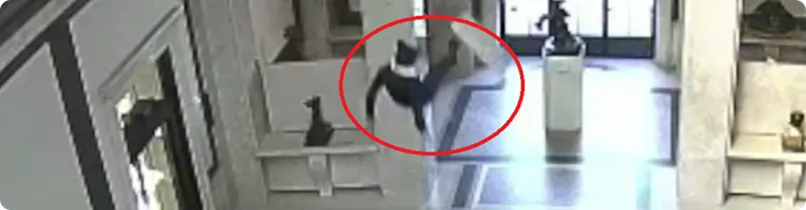
A tragic example below: A worker was injured while crossing a glass floor during an inspection at the Rodin Museum and received €7.25 million in compensation:
Occupational Diseases
- Prolonged exposure to non-compliant equipment leads to costly occupational diseases.
- For example:
- Excessive noise → Occupational deafness: A worker in a metallurgical plant uses a hydraulic press daily, with noise levels exceeding 90 dB. Due to a lack of appropriate hearing protection and regular noise level monitoring, he develops progressive hearing loss, requiring medical care and expensive hearing aids.
- Excessive vibrations → Musculoskeletal disorders (MSDs) and carpal tunnel syndrome: A construction equipment operator uses a jackhammer that does not meet anti-vibration standards. After several years, he develops chronic pain in his wrists and shoulders, requiring prolonged sick leave and surgery.
- Toxic products → Respiratory diseases and occupational cancers: An industrial painter applies paints containing toxic solvents daily, but his protective mask is poorly maintained and ineffective. After several years, he develops chronic obstructive pulmonary disease (COPD), preventing him from continuing to work.
⚖️ Penalties and Criminal Liability
Failure to Comply with Legal Obligations
- A company that fails to comply with regulatory inspections faces fines ranging from €1,500 to €15,000 per violation.
- In case of repeat offenses, these fines can double and lead to a business ban.
For example: during the Paris Olympics, labor inspectors halted the assembly of stands on three different construction sites.

These interruptions affected the sites at Versailles, Place de la Concorde, and the Eiffel Tower.
These stoppages were more often due to the absence of adequate collective or individual protections rather than a lack of maintenance of these protections.
Liability in Case of Accidents
- If an accident is caused by poorly maintained equipment, the company director can be prosecuted for endangering others’ lives.
- A company was fined €500,000 for a fatal accident caused by security inspection failures.
Litigation Costs
- A lawsuit can cost between €10,000 and €200,000 in legal fees and compensation.
The 6 Steps
1️⃣ Identify and List All Equipment
📌 Why? Gain a clear overview of available equipment, prevent losses, and improve traceability.
✅ How?
- Create a detailed inventory: equipment type, serial number, brand, model.
- Assign each piece of equipment to a department or responsible employee.
- Use a PPE management software to centralize information.
- Ensure a risk analysis is conducted regarding the use of this equipment and your team’s work environment.
➡️ Solutions:
You must gather the following information for all your equipment:
- Brand
- Model
- Serial Number
- Reference
- Status (Usable, Discarded, To be Repaired, or Unusable)
- User
- Description
- Manufacturing Date
- Lifespan (years)
- End of Life Date
- Commissioning Date
- Inspection Interval (months)
- Last Inspection
- Next Inspection
- History of all past inspections (legal requirement)
- Equipment Documents: invoice, certificates, manuals, inspection sheet…
For this, you have two solutions:
| Manual Management | Software Management |
|---|
| Manual management is often done by the team or workshop manager in Excel or Google Sheets | Software on computer, tablet, and mobile. It centralizes and automates the management of equipment and inspections. |
➕ Quick to set up
➖ Time-consuming
➖ Error-prone
➖ No traceability
➖ Not collaborative with teams
➖ No alerts or reminders when equipment becomes non-compliant | ➕ Ensures compliance
➕ Flawless traceability
➕ Time-saving
➕ Team accountability
➕ Reduces losses and thefts
➕ Turnkey solution
➕ Predictable pricing: unlimited users |
Example:
Download a free example (Excel) | Example:
Try the free version of GearTracker |
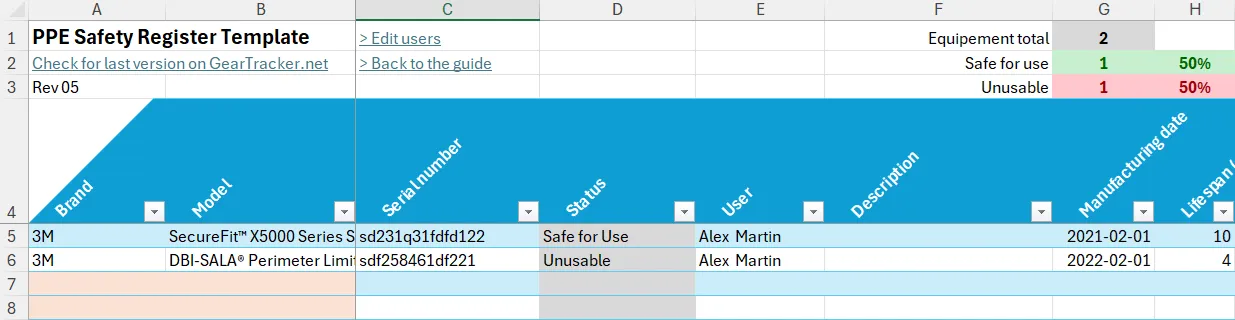
Example of an Excel management file ( here ):
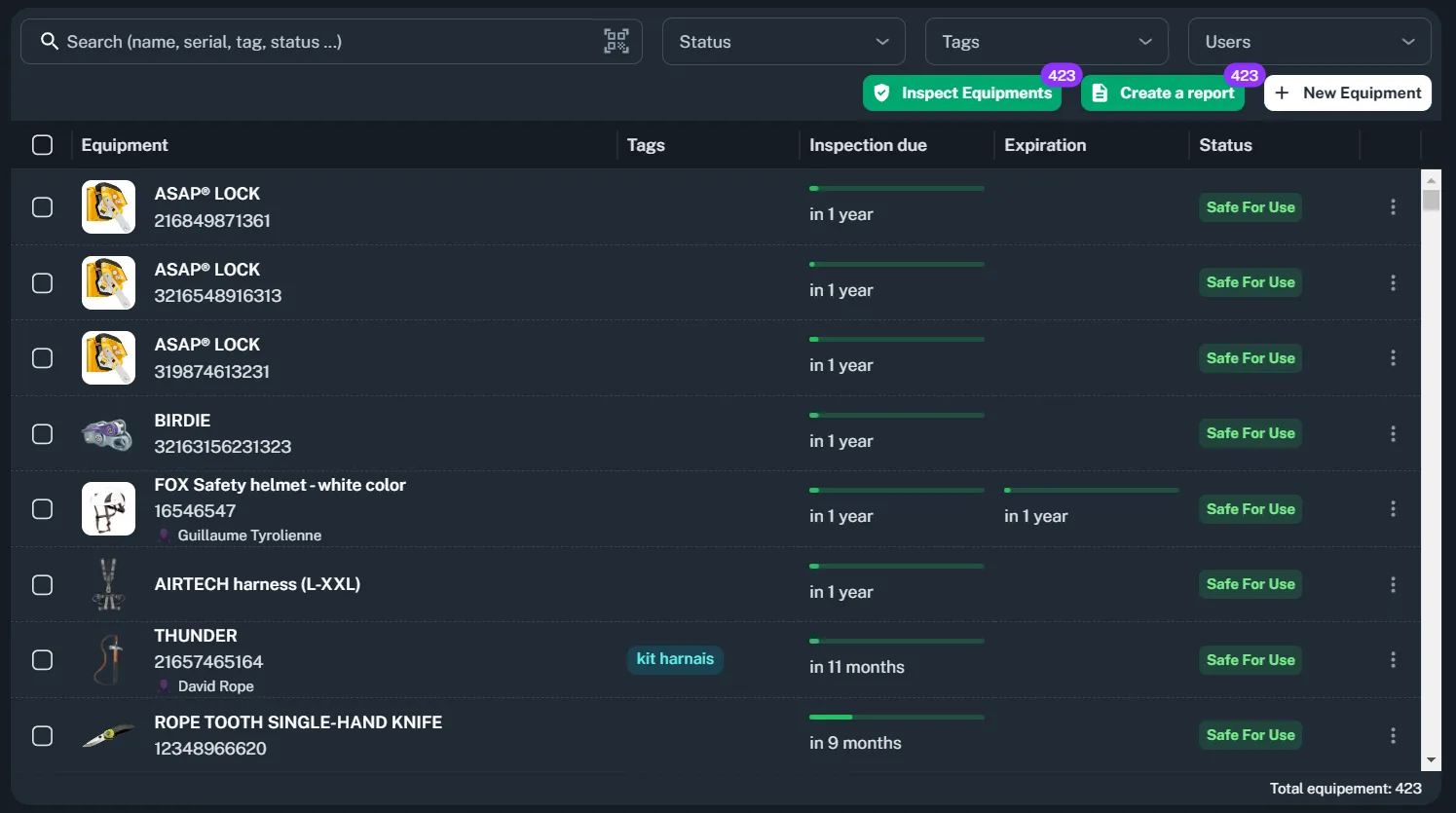
Example of an equipment management application (GearTracker):
2️⃣ Implement Accurate Tracking
📌 Why? Ensure equipment availability and prevent operational disruptions.
✅ How?
- Assign unique identifiers (QR code, RFID, inventory number).
- Track movements and loans (borrowings, returns).
- Record usage hours to anticipate wear.
Assign Unique Identifiers
Assigning a unique identifier (Barcode, QR code, RFID, NFC, inventory number) to equipment allows precise tracking, better inspection management, and time savings during inventories. Here are different available solutions and options for attaching tags to equipment.
| Equipment Type | Recommended Solution |
|---|
| Helmets, harnesses, clothing | Sewn or heat-pressed textile label with 1D-2D Code/RFID/NFC |
| Fire extinguishers, gas cylinders | Engraved metal plate or encapsulated 1D-2D Code/RFID/NFC tag |
| Hand tools | Engraved number or industrial sticker with 1D-2D Code/RFID/NFC |
| Industrial machines | Riveted metal plate or screwed tag |
| Plastic or composite equipment | Industrial sticker or glued plastic plate |
| Large or irregularly shaped objects | Cable tie with 1D-2D Code/RFID/NFC tag |
Track Equipment Movements, Allocations, and Loans
You must track equipment movements to hold your teams accountable.
Losses and thefts of equipment are mainly due to a lack of traceability. Users are now responsible for the equipment assigned to them.
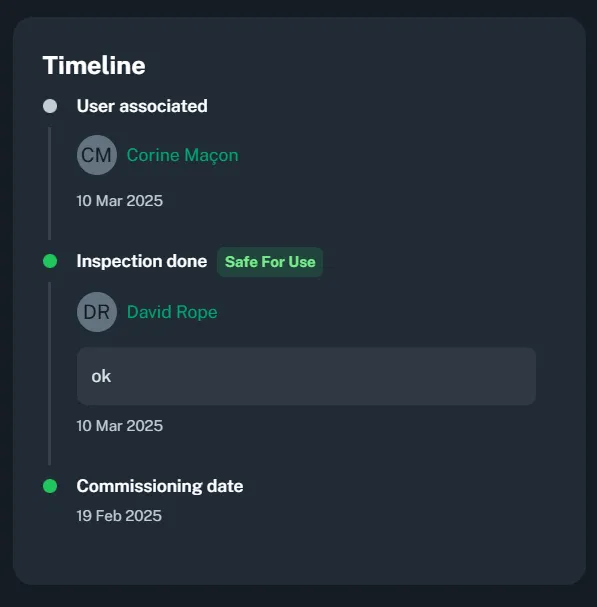
To achieve this, add to your management system the information on who is currently using the equipment.
Here is an example of the history you should obtain for equipment:
3️⃣ Plan Maintenance and Regulatory Inspections
📌 Why? Prevent breakdowns, ensure safety, and comply with regulations.
✅ How?
- Establish a preventive maintenance schedule.
- Set up alerts for mandatory inspections.
- Standardize maintenance procedures.
Maintenance Schedule
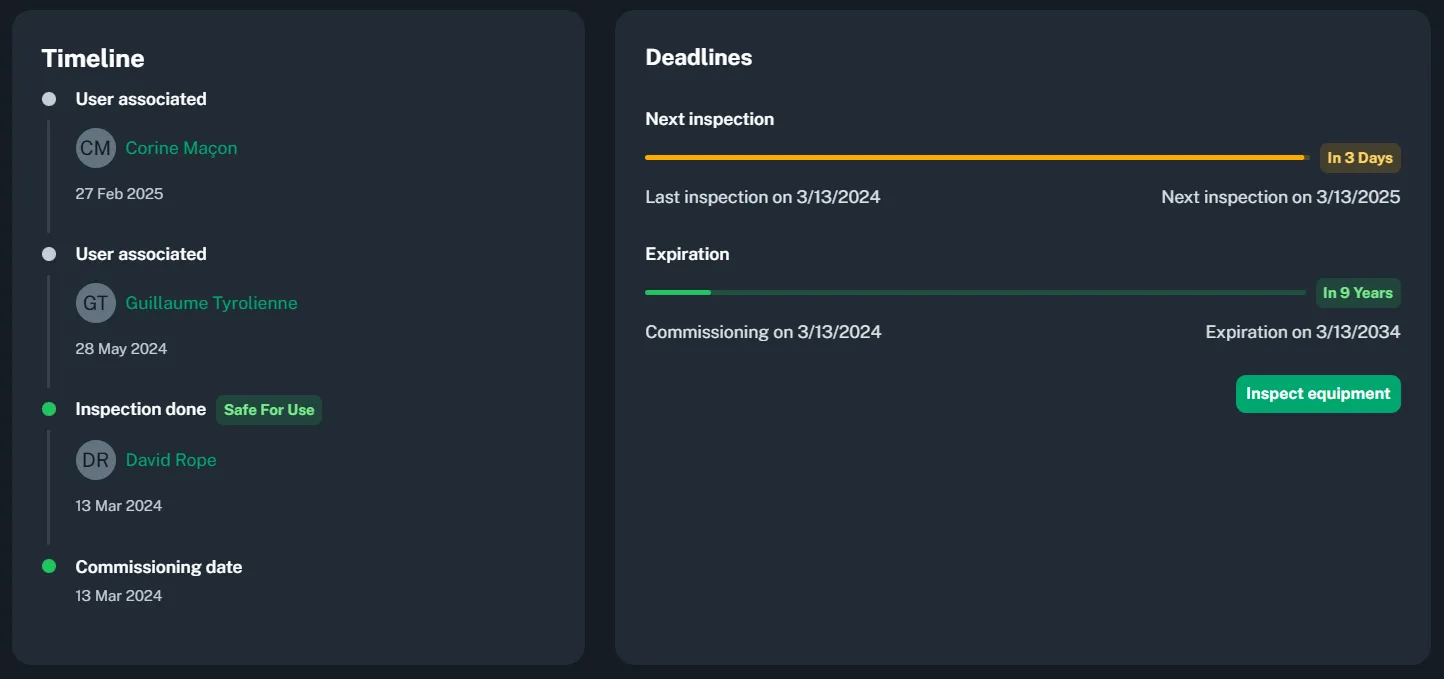
To avoid missing inspection and end-of-life deadlines for your equipment, you need a system that alerts you when a deadline is approaching.
Here is an example of the information you should monitor in Excel or your software:
Notifications
Next, you need to set up the following notifications:
- An email alert 1 month before an inspection or equipment expiration.
- A monthly email summary of the status of your equipment, allowing you to assess the number of items needing repair, unusable, or nearing deadlines and act accordingly.
If you use Excel, setting up these notifications will not be possible. However, you can open your file weekly to check that nothing is nearing its deadline.
Standardize Inspection Steps
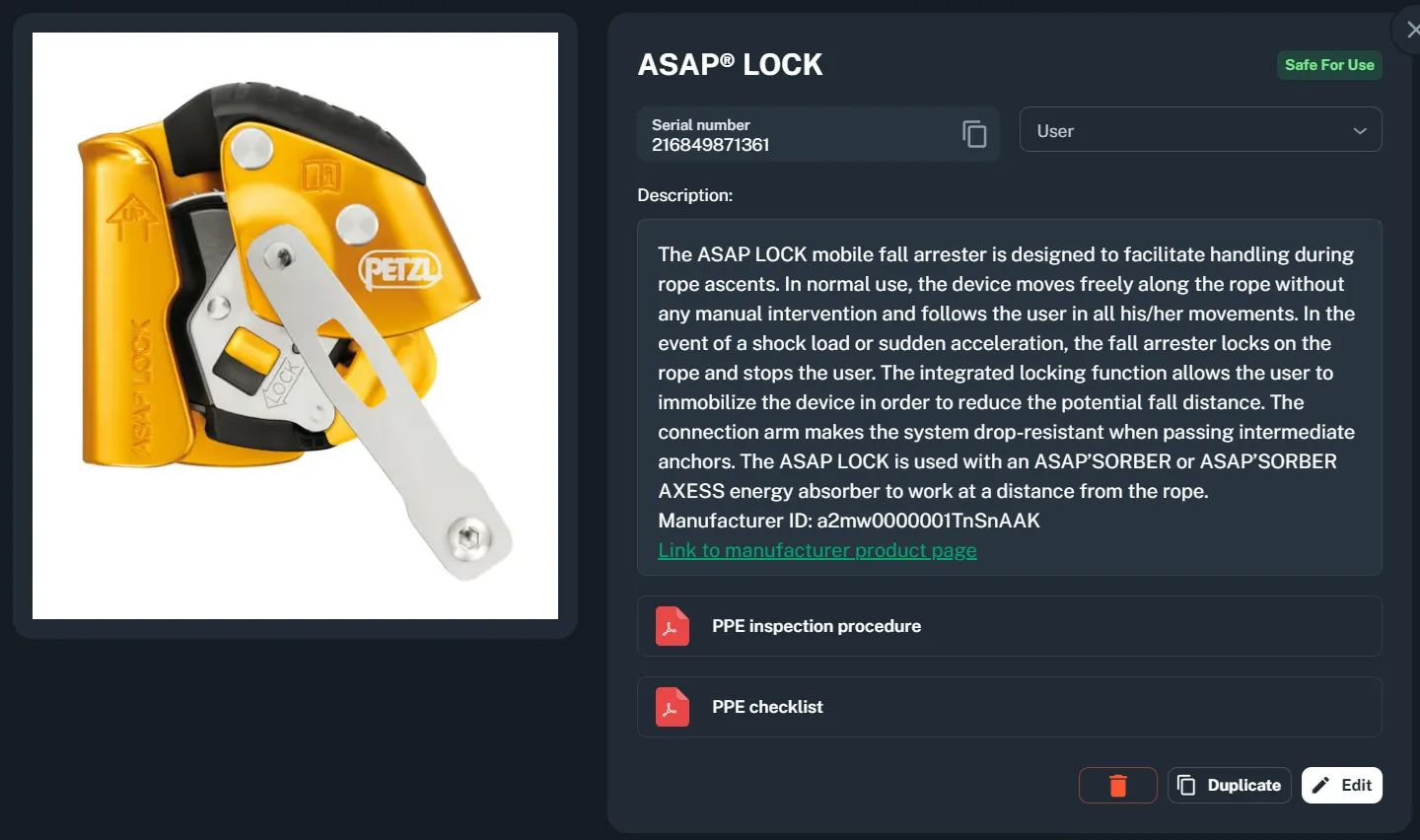
To save time and ensure the safety of equipment and teams, you must follow the manufacturer’s manual. It is therefore essential to attach this document to the equipment.
- In Excel, you can link to the PDF in your shared space.
- In your software, you can attach the PDF file and open it during inspections.
For example:
4️⃣ Managing Equipment Lifecycle
📌 Why? Optimize costs by anticipating renewal.
✅ How?
- Track usage history and repairs.
- Assess equipment profitability and performance.
- Define replacement criteria.
Organize an annual or semi-annual meeting to review your equipment. Schedule this meeting right after your general inspection or inventory to ensure up-to-date information.
During this meeting, you should evaluate:
- The condition of your equipment based on operational needs
- Equipment to be replaced
- The associated budget
- Potential issues, such as:
- Statistics on loss rates
- Statistics on breakage rates
- Disparities between teams, etc.
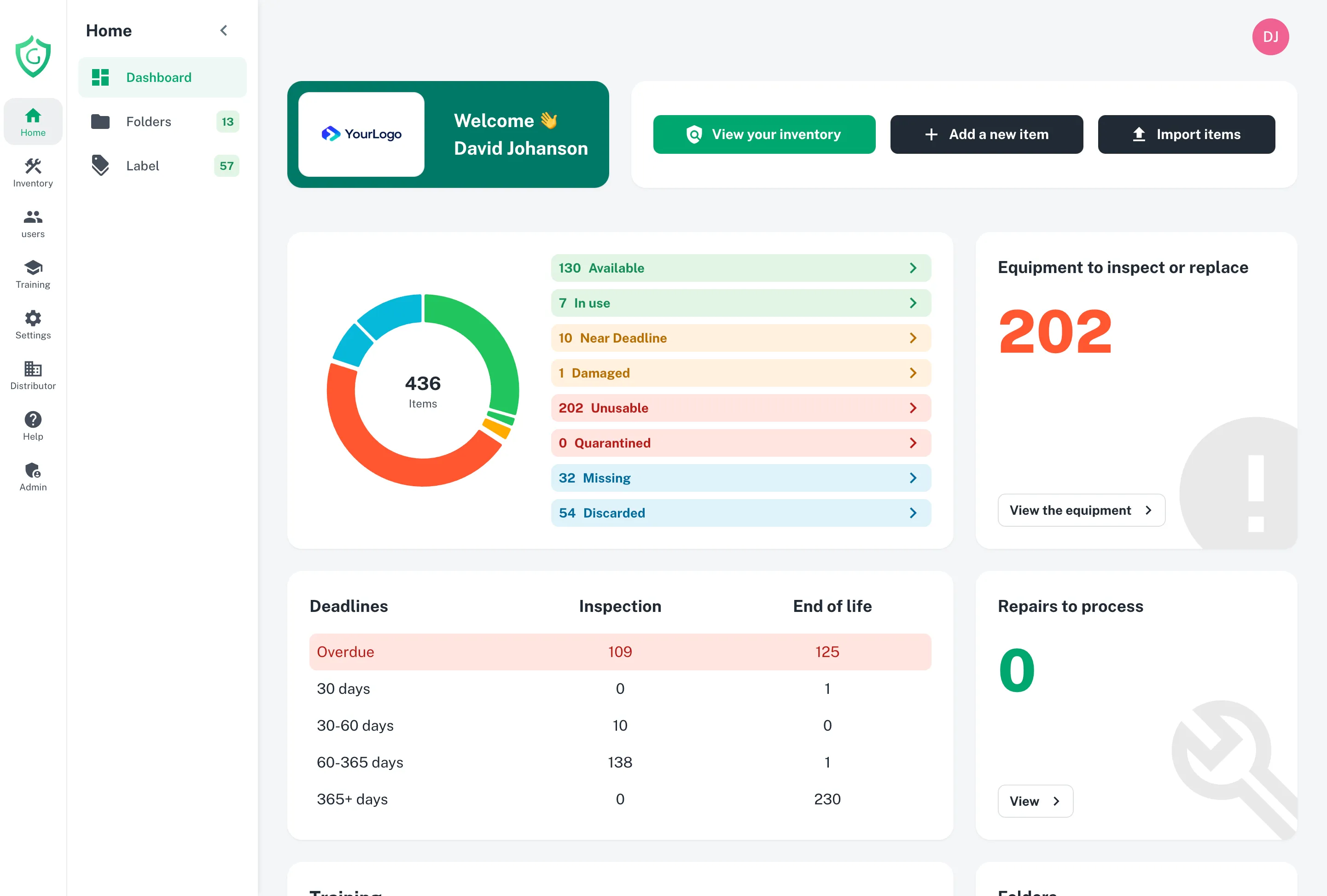
Example of a dashboard section:
5️⃣ Training Users and Managers
📌 Why? Reduce usage errors, extend equipment lifespan, and improve safety.
✅ How?
- Organize regular training sessions.
- Raise awareness of proper handling and storage practices.
- Appoint equipment referents in each department.
To ensure employee and equipment safety, it is essential to conduct regular training sessions on their application, usage, and maintenance. These sessions help employees better understand how the equipment works, adopt best practices, and optimize its lifespan. Proper training also reduces the risk of premature wear and incidents caused by improper handling.
Finally, appointing equipment referents in each department ensures rigorous monitoring and effective communication about best practices. These referents play a key role in equipment management by relaying instructions, monitoring equipment conditions, and reporting any necessary interventions. Their presence guarantees better coordination and shared responsibility within teams.
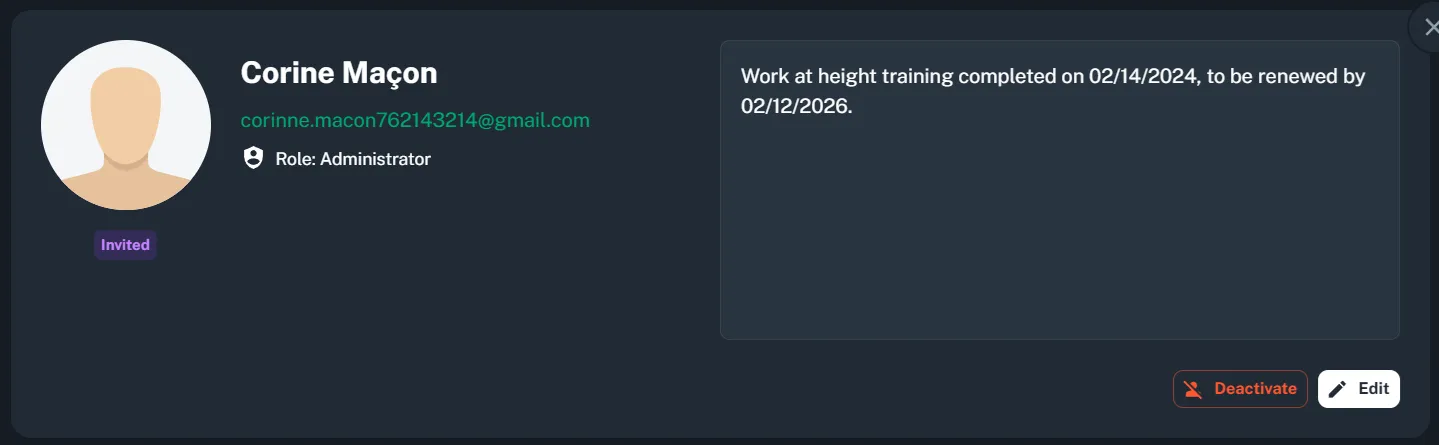
Example of user information for an employee required to work at height:
6️⃣ Ensuring Regulatory Compliance
📌 Why? Avoid legal penalties and ensure employee safety.
✅ How?
- Monitor legal obligations specific to each type of equipment.
- Keep compliance documents up to date.
- Conduct internal audits.
Perform Your Periodic Inspections
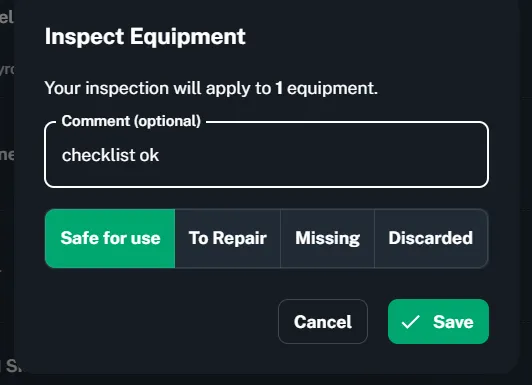
Regularly inspect your equipment to verify its condition, proper operation, and compliance with current standards and manufacturer documentation. This includes a visual inspection for wear, functional tests if necessary, and recording observations in a log.
Example of an equipment inspection:
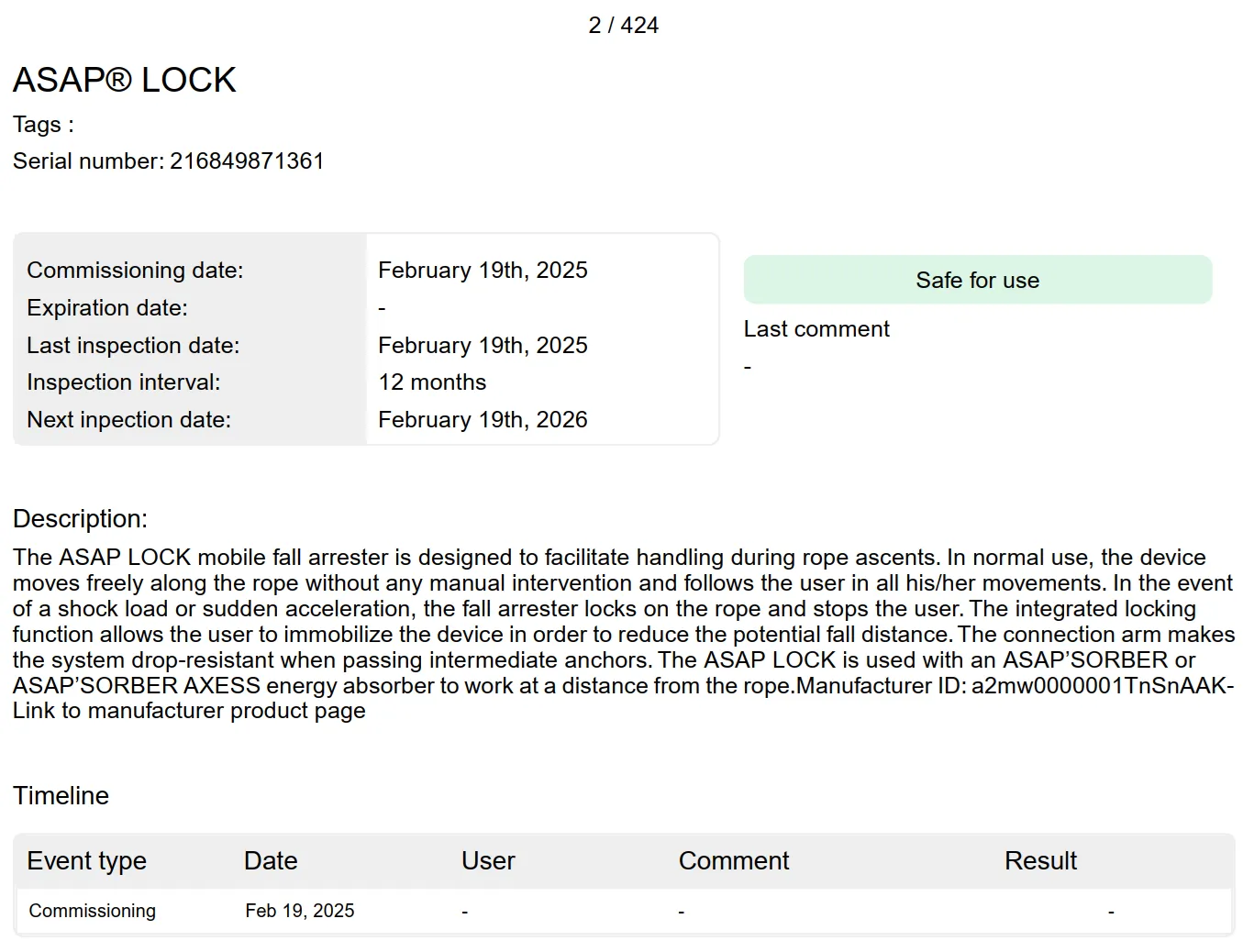
To generate compliance reports on demand, it is essential to centralize inspection data in a dedicated tool. Proper tracking enables the rapid generation of a detailed document outlining equipment conditions, completed inspections, and any necessary corrective actions.
Excerpt from one of the 424 pages of a compliance report generated by the GearTracker software:
If you do not have such a tool, you can provide your Excel file to the requesting party (labor inspection, insurers, users).
Conclusion
It is entirely possible to manage your equipment using an Excel or Google Sheet file if you are meticulous.
Management via Excel or Sheets
As a reminder, we offer a free Excel template to help manage this issue.
Download the Safety Register Template (Excel) Download the Safety Register Template (Excel)
Fill in your email: your file is waiting for you in your GearTracker account.
Get the file (free)
By continuing, you create a free GearTracker account and accept the terms of use and the privacy policy.
Your email seems to be invalid. Please check it.
Oops! An error occured.
However, you should be aware of the limitations of this approach and the risks for team leaders and employees:
| Features | Excel | GearTracker |
|---|
| Safety equipment repository | Yes | Yes |
| Centralization of PPE users | Yes | Yes |
| Verification and event history | Limited | Yes |
| Adding manuals and documents | No | Yes |
| Instant search for equipment via barcode scan | No | Yes |
| Sharing information with PPE users | No | Yes |
| Protection against input errors | Limited | Yes |
| Access control management (read, write, inspectors) | No | Yes |
| PDF report generation for compliance proof | No | Yes |
| Delegation to an external VGP company | No | Yes |
| Mobile access | Limited | Yes |
| Automatic alerts (upcoming inspection, expired equipment) | No | Yes |
| Elimination of legal risks due to stock oversight | No | Yes |
➡️ If you want an automated, secure, and collaborative tool, activate GearTracker’s free plan: Create an account
Management via Software
We recommend using software if:
- You own more than 100 pieces of equipment
- Or their value exceeds €3,000
- Or you have employees using your equipment.
Our application is available for free:
Create a free account
Our software is used by associations, small businesses, and large industrial groups. It is also distributed by PPE specialists, such as Reinert in Luxembourg , which offers it to its own customers.