The equipment and PPE side of an OH&S management system, clause by clause
How GearTracker helps you meet ISO 45001
ISO 45001 never sets an inspection interval. It requires you to identify the ones your law imposes, prove you meet them, and make that proof available where the work happens. That is exactly what GearTracker produces.
ISO 45001 in brief
ISO 45001 is the international standard for occupational health and safety management systems. Published in 2018, it replaced OHSAS 18001 and has become the third most certified management system standard in the world: 542,527 valid certificates covering 941,546 sites in 2024, behind only ISO 9001 and ISO 14001.
Like every recent management system standard, it follows the common high-level structure of 10 clauses, organized around the Plan-Do-Check-Act cycle. The first three are introductory; the seven that follow carry the auditable requirements:
| Clause | Title | What it requires |
|---|---|---|
| 4 | Context of the organization | Understand your environment and interested parties, define the scope of the system |
| 5 | Leadership and worker participation | Top management commitment, OH&S policy, and effective consultation of workers |
| 6 | Planning | Hazards, risks, applicable legal requirements, measurable OH&S objectives |
| 7 | Support | Resources, competence, awareness, communication, documented information |
| 8 | Operation | Operational control, hierarchy of controls, change, procurement, emergencies |
| 9 | Performance evaluation | Monitoring and measurement, evaluation of compliance, internal audit, management review |
| 10 | Improvement | Incidents, nonconformity and corrective action, continual improvement |
A few markers before you start:
- Certification is issued by an accredited certification body, not by ISO itself.
- The cycle runs three years: a two-stage initial audit, then annual surveillance audits, then a recertification audit.
- The audit combines document review, observation of work as it is actually done, and interviews with workers at every level.
- Findings are classified as major or minor nonconformities; a major blocks certification until it is closed out with a verified corrective action.
- The standard is generic: it applies to any organization of any size in any sector. That is its strength, and the reason it will never tell you how often to inspect a harness.
note
ISO 45001 adoption in the United States is still modest — around 2,400 certificates, ranking the country 20th worldwide — but it is climbing fast, driven by multinational parent companies, by owner-client prequalification, and by organizations that want a system rather than a compliance checklist. This page covers the equipment and PPE side of such a system: the part GearTracker covers, and one of the most time-consuming to prepare.
What the standard actually requires about equipment
Open ISO 45001 looking for “annual PPE inspection” and you will find nothing. It is disconcerting the first time, and it is also the key to the whole subject.
ISO 45001 is a management system standard. It prescribes no technical rule; it organizes how you will identify your obligations, meet them, and prove it. For an equipment inventory, that plays out in three requirements that chain together.
- Clause 6.1.3 — You must know what the law requires of you. The standard requires you to determine the legal requirements applicable to your hazards and to understand how they apply. Translation: the inspection interval for every item you own must be identified, justified and documented. Your national and state law sets it, not the standard.
- Clause 9.1.2 — You must prove you meet them. This is the direct counterpart to 6.1.3: evaluate compliance with those requirements at a defined frequency, evaluate the results and retain the documented information. A register of obligations with no evidence of execution is a nonconformity, not a system.
- Clause 7.5.3 — The evidence must be where the work happens. This is the most underestimated requirement of all: documented information must be available and suitable for use where and when it is needed. A manufacturer’s manual perfectly filed at headquarters, but unreachable by the technician at the top of a tower, does not satisfy it.
ISO 45001 does not ask you to inspect your PPE every twelve months. It asks you to know who requires it, to prove you do it, and to make that proof reachable at the point of work.
Where PPE sits in the hierarchy: better to own it
Clause 8.1.2 requires you to apply a hierarchy of controls, in this order: eliminate the hazard, substitute it, use engineering controls and reorganization of work, use administrative controls including training, and finally use adequate personal protective equipment. PPE comes last because it protects one individual instead of removing the risk at source.
So let us be blunt: GearTracker eliminates no hazard and substitutes nothing. An auditor seeing an action plan resting entirely on PPE would immediately record that clause 8.1.2 is not being applied — and they would be right.
But the last rung is still a rung, and the standard asks for adequate PPE. A harness whose inspection has expired, a fall arrester issued to someone without the matching authorization, an item past its service life still in circulation: none of those is adequate PPE. Preventing precisely that is what the tool does.
warning
What ISO 45001 does NOT require. It mandates no software, no document format, no numeric interval, and no particular inspection provider. Any vendor selling you an “ISO 45001 requirement” to buy their tool is telling you a story. The interval obligation comes from OSHA, ANSI and your manufacturers; the standard only requires you to know it, meet it and be able to prove it.
Clause by clause: the GearTracker answer
Clause numbers below refer to ISO 45001:2018. Requirements are paraphrased, never quoted: the text of the standard is copyrighted and must be purchased from ISO or ANSI.
Legal requirements, hazards and objectives
Competence and documented information
Operational control, hierarchy of controls and procurement
Monitoring, compliance evaluation and internal audit
Nonconformity and corrective action
Your legal register in the United States
Clause 6.1.3 obliges you to identify the applicable rules; clause 9.1.2 to prove you meet them. Here is what that covers in practice under US law for an equipment inventory, and what the tool does with it.
| Rule | What it requires | What GearTracker does with it |
|---|---|---|
| 29 CFR 1910.132(d) | A workplace hazard assessment, verified by a written certification identifying the workplace evaluated, the person certifying, the date(s), and the document as a certification of hazard assessment | The assessment stays yours, but the inventory gives it a factual basis: what is deployed, where, on whom, and in what condition |
| 29 CFR 1910.132(e) | “Defective or damaged personal protective equipment shall not be used.” The shortest sentence in the standard, and the one that makes inspection unavoidable | An item marked “to repair”, “missing” or “discarded” is visibly out of service until it returns to “safe for use”. The status is carried by the item, not by someone’s memory |
| 29 CFR 1910.132(f) | Training on PPE use, verified by a written certification naming each employee trained, the date(s), and the subject | The training register records each training with its supporting document, its date and its refresher due date, per user |
| 29 CFR 1910.134 | Written respiratory protection program: fit testing, medical evaluation, cleaning, inspection and maintenance records. Note that the 1910.132(d) and (f) certifications do not apply here — 1910.134 carries its own, stricter requirements | Respirators, cartridges and filters are tracked with their own intervals and their own history, including expiry-driven replacement of consumables |
| ANSI/ASSP Z359.2 and 29 CFR 1910.140 | For fall protection: a pre-use inspection before every shift and a documented inspection by a competent person at least annually, with immediate removal from service on failure | 12-month interval, alert 30 days before the due date, and an inspection history naming the competent person who performed it — the record Z359.2 asks for and that spreadsheets never hold |
| Manufacturer’s instructions | Wherever no rule sets an interval, the manufacturer’s instructions govern — and where OSHA, ANSI and the manufacturer differ, the most stringent wins | Interval configurable item by item; the built-in catalog pre-fills instructions for major brands (Petzl, Beal, 3M, CAMP, Edelrid and others) |
note
This table covers the United States, and federal OSHA only: about half of the states run their own OSHA-approved State Plans, which must be at least as effective and are sometimes stricter. ISO 45001 being international, each site must build its own register — the French, German, Spanish and Italian versions of this page cite the rules of their own markets. That is a real watch point for multi-country groups: one ISO 45001 system has to absorb as many legal registers as it has countries.
The 6 pieces of evidence an auditor will sample
An ISO 45001 auditor does not read your whole inventory. They pull two or three items in the field and walk the evidence chain backwards. If a link is missing, that is a finding — and the next sample will be wider.
| Evidence expected | Clause | Where to get it in GearTracker |
|---|---|---|
| The register of legal requirements applicable to your equipment, with the intervals they drive | 6.1.3 | The interval carried by each item, exported with the inventory |
| The record of inspections performed: date, author, result | 9.1.2 | Item history, with checklist answers retained |
| Documented information available at the point of work | 7.5.3 | Item record reachable by NFC or QR scan, instructions and certificate included |
| Evidence that the wearer is competent and authorized for the equipment they use | 7.2 | Per-user compliance view: training, authorizations, refresher dates, assigned equipment |
| The documented handling of a finding, through to closure | 10.2 | ”To repair” / “missing” / “discarded” statuses with comment, then a dated return to “safe for use” |
| Monitoring and measurement results, quantified and tracked over time | 9.1.1 | Dashboard and dated PDF or CSV export |
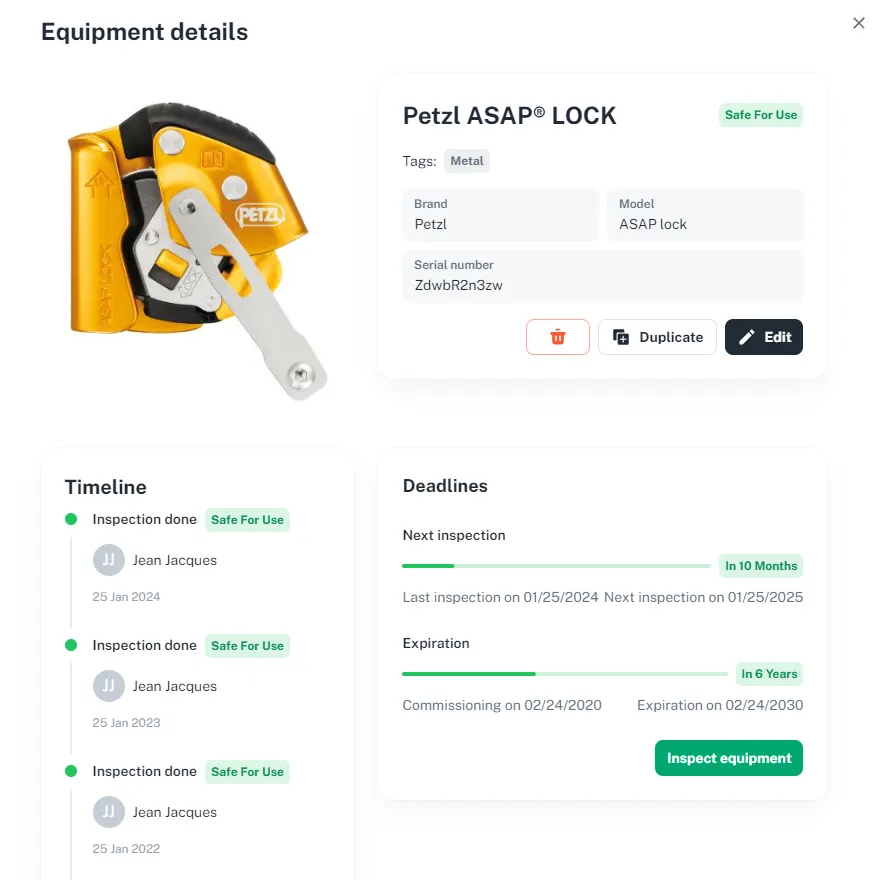
The whole evidence chain on one screen, reachable by scanning the item: identification, inspection timeline with who performed each one, applied interval and end of life. This is what clauses 7.5.3 and 9.1.2 are asking for.
Clause 10.2: the finding, the corrective action, the closure
Clause 10 is the one organizations document worst, because it means keeping a record of your own failures. The standard requires, for every nonconformity, that you react, evaluate the causes, take the actions needed, review their effectiveness, and retain documented information about them.
For an equipment inventory, the good news is that this loop already exists, provided it is tooled. An item switched to “to repair” during an inspection, with comment, photo and author, is a nonconformity record. It stays visible on the dashboard until it is brought back into compliance. Its return to “safe for use”, dated and attributed, is the evidence that the corrective action was taken and verified.
What an auditor is looking for at that point is not an inventory without findings — an inventory with no findings at all is suspicious, exactly like an internal audit report with no nonconformities. What they are looking for is the elapsed time between detection and closure, and evidence that nobody kept using the item in between.
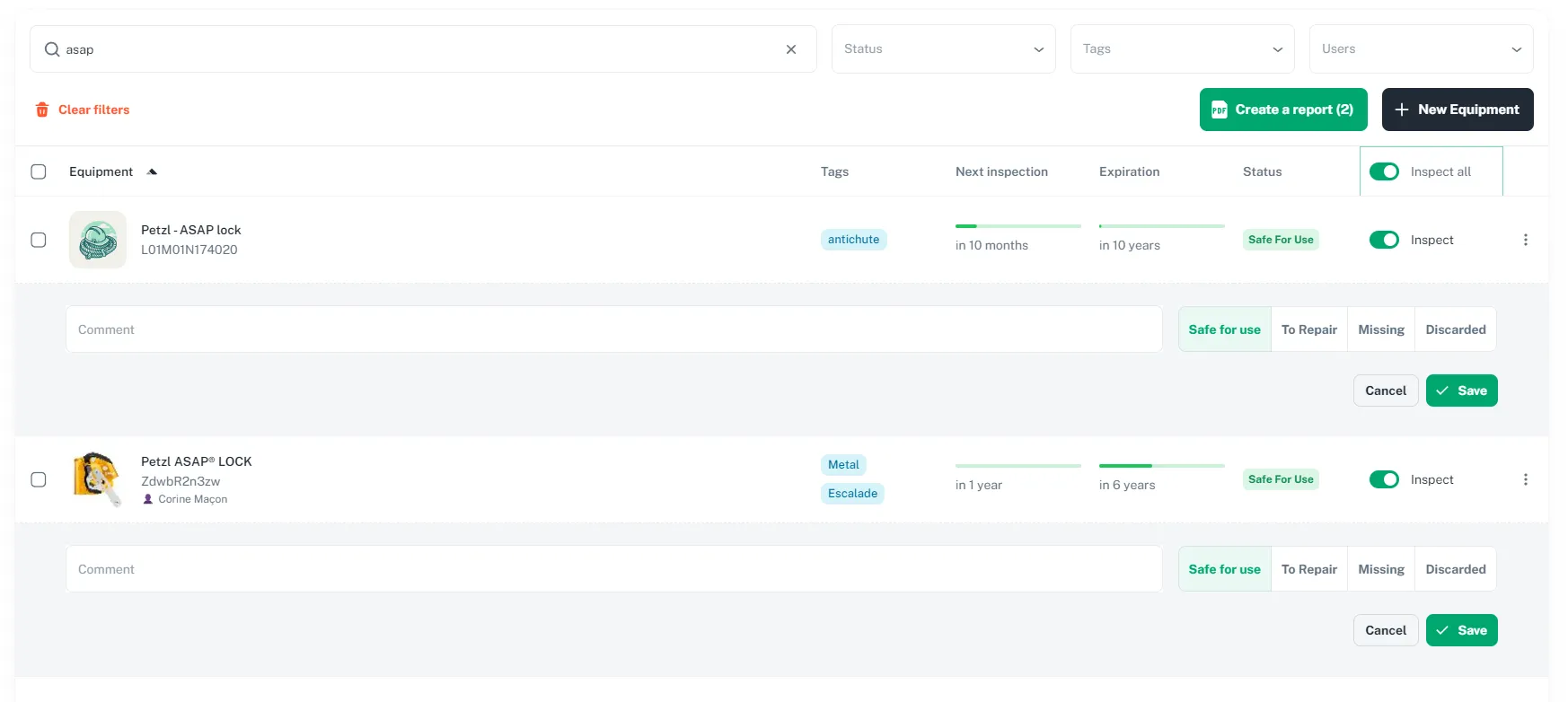
Every inspection leaves a dated, attributed, commented record. A “to repair” status opens the nonconformity; the return to “safe for use” closes it.
Clauses 9.1 and 6.2: turning compliance rate into an OH&S objective
Clause 6.2 requires OH&S objectives to be measurable — and this is one of the points where management systems get pulled up most often. “Improve safety” is not an objective; “reach 98% compliant equipment and zero overdue inspections by 31 December” is, because it can be measured, monitored and demonstrated.
It is also an objective you do not have to calculate: the compliance rate is produced mechanically and continuously from due dates and statuses. It then feeds clause 9.1.1 (monitoring and measurement), clause 9.1.2 (evaluation of compliance) and the clause 9.3 management review, without a single line being recounted by hand.
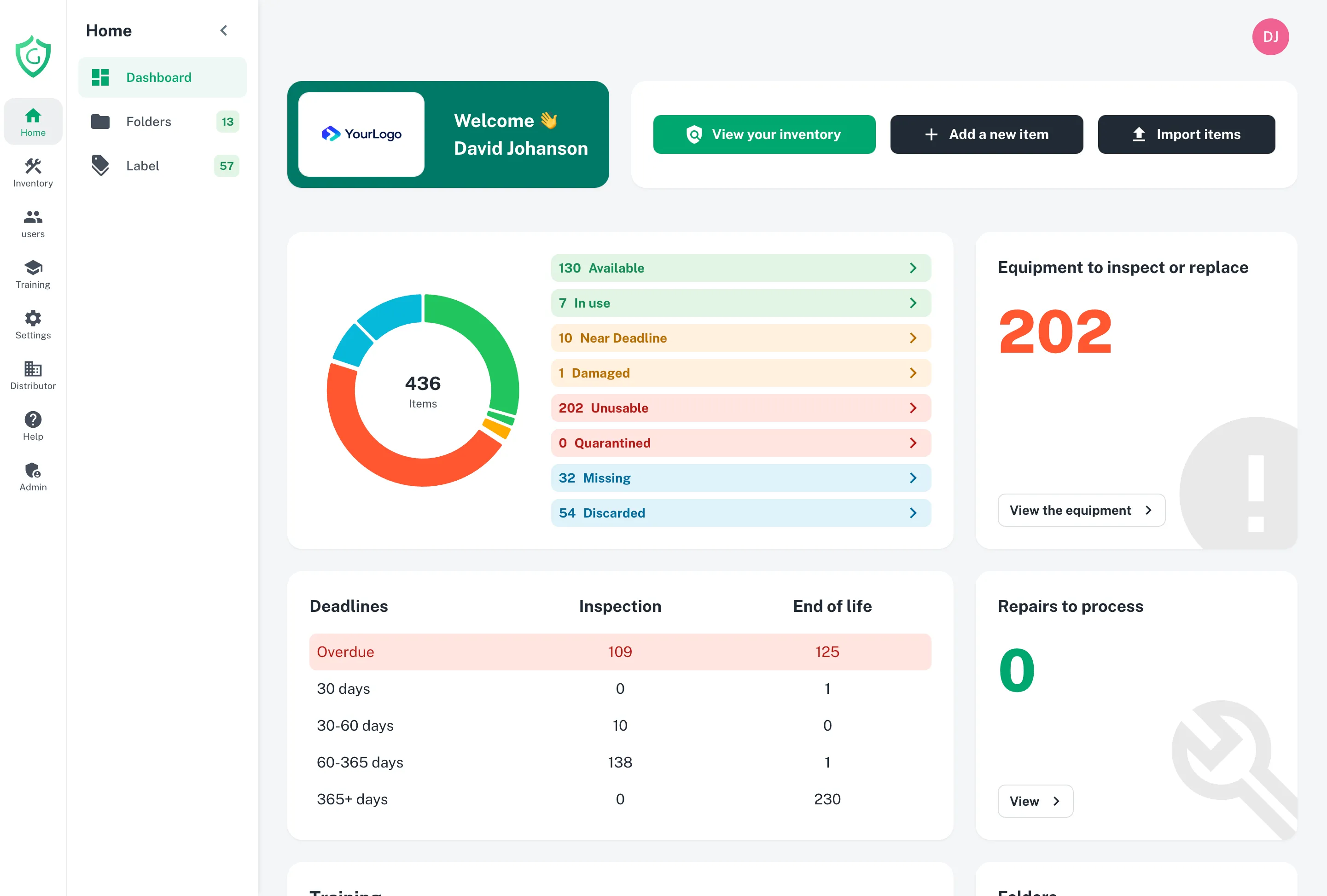
Compliance rate, overdue due dates, items to inspect or replace: the value of your OH&S objectives, permanently available rather than reconstructed before the management review.
What GearTracker does not do
ISO 45001 is a complete management system: an equipment tool covers only part of it. Better to know that before the certification audit.
ISO 45001 requirements to handle by other means
The ISO 45001:2027 revision is coming
ISO 45001 has been under revision since 2024. The draft has reached DIS stage (Draft International Standard) and publication of ISO 45001:2027 is expected around the middle of 2027, with a transition period likely to be about three years — matching those set for ISO 9001:2026 and ISO 14001:2026, the latter published on 15 April 2026.
The announced themes broaden the scope of the standard noticeably:
- Worker well-being, not only health and safety in the narrow sense.
- New ways of working, including remote and hybrid arrangements.
- Workforce diversity — gender, age, disability — in hazard identification.
- Climate change, formally integrated into requirements as in the other recent management system standards.
- Emerging technology, with specific attention to artificial intelligence.
- Return to work after injury or illness, and control of externally provided services.
Should you wait? No. None of these themes changes the mechanics of documented information about equipment: you will still have to identify your legal obligations, prove you meet them and make the proof reachable at the point of work. An inventory structured today will cross the transition without rework, and you will have three years to align the rest of the system.
note
One timing point does deserve attention: if your recertification audit falls after publication, your certification body will expect you to be aligned with the new version. Better to lay down now the building blocks that will not move.
Getting the equipment side of your ISO 45001 audit ready in 6 steps
The order matters: each step makes the next one cheaper.
Build the legal requirements register for your equipment
Inventory every item concerned
Put the interval on each item
Attach the documented information to each record
Standardize inspections with checklists
Produce your compliance evaluation and your metrics
Why GearTracker for an ISO 45001 system
- Clause 6.1.3 becomes operational — the interval is no longer a line in a theoretical register; it is carried by the item itself and triggers alerts.
- Clause 9.1.2 comes out in one click — the dated PDF or CSV export of the inventory and its inspections serves as your compliance evaluation record.
- Clause 7.5.3 is satisfied in the field — NFC or QR scan, and the evidence opens where the work happens, even on a phone with no account.
- Clause 10.2 closes natively — the finding, its author, its comment and its closure date, with no parallel register to maintain.
- One inventory for everything — PPE, collective protection, lifting gear, access equipment, extinguishers, power tools, vehicles: the scope of the system does not stop at PPE.
- Training and authorizations in the same place — so you do not lose at clause 7.2 what you gained at clause 8.1.
- Free up to 100 items, with no time limit and no credit card: you can start your inventory today.
For more on the tool itself, see our PPE management software page, or the enterprise offering if you manage several sites.
note
ISO 45001 is a standard published by the International Organization for Standardization. GearTracker is not affiliated with ISO, is not a certification body and is not a consultancy: certification is issued by an accredited certification body. The requirements discussed on this page are paraphrased, not quoted — the text of the standard is copyrighted and must be purchased from ISO or ANSI. Always confirm the applicable version with your certification body.
FREE
Discover simple and efficient equipment management for free with no time limit. Ideal for individuals, small associations or businesses.
- 100 equipment maximum
- Unlimited users
- Inspections and repairs management
- Training management
- Folders and labels
- Transfer management
- NFC and barcodes
- Reports, alerts and history
PRO
Large-scale equipment management
- 20,000 equipment maximum
- Everything in FREE plan, plus:
- Your logo in the application
- Email support
- Credit card payment
Custom
You have specific needs or large equipment volumes, contact us and we will work together to set up a tailored solution.
- Unlimited equipment
- Everything in PRO plan, plus:
- SSO and identity management integration
- Custom payment terms
- Specific contractual conditions
- Checked import of your existing equipment
- Priority message support
- Phone support (EN and FR)
FAQ – GearTracker and ISO 45001
Whether large companies or associations, they trust us


Audrey G.
HSE Manager at Capgemini
This tool is a real performance driver for our business. The platform is intuitive, seamless, and particularly easy to use. Quick access to information and the automation of many tasks enable us to save significant time every day while improving the efficiency of our processes.
Thanks to this solution, our teams can focus on higher-value tasks, which directly helps improve our productivity. Reliable, high-performing, and perfectly suited to our needs, this tool brings real added value to any organization looking to optimize its operations and become more efficient. I highly recommend it.


Christian M.
Warehouse Manager at Bonduelle
Since we started using GearTracker last year, our experience has been extremely positive.
The platform has significantly simplified the management of our personal protective equipment (PPE) and other regulated equipment. Features such as deadline alerts, incident tracking, and repair monitoring have allowed us to save valuable time and ensure the safety of our teams.
What truly sets GearTracker apart is the quality of relationships with the founders. Their responsiveness is exemplary. Their personalized support has made all the difference, making the integration of the solution smooth and efficient. We highly recommend GearTracker to any organization looking to optimize their equipment management.

Alexis R.
CAF Annecy
At CAF Annecy, we were looking for a simple and effective solution to manage our PPE. With GearTracker, setup was quick and intuitive. From the very first days, volunteers were able to use the application without any training or user manual. For us, that is proof of well-designed software.
The GearTracker team is another real strength. Our suggestions for improvements are genuinely heard, and several have been incorporated into subsequent updates.
GearTracker is a modern, reliable, and constantly evolving solution. It saves us valuable time in managing our PPE and allows us to focus on what matters most: our activities. We recommend this solution to any association or organization looking to simplify the management of its equipment.


Streamlined equipment management for teams and individuals.
Manage equipment across teams, locations, vehicles, and more! Track the lifecycle of your gear, get access to manufacturer data. Ensure compliance, reduce losses and theft, and save time.